The new Interreg ITACA project showcased as an example of innovation at the DIGIVIT trade fair
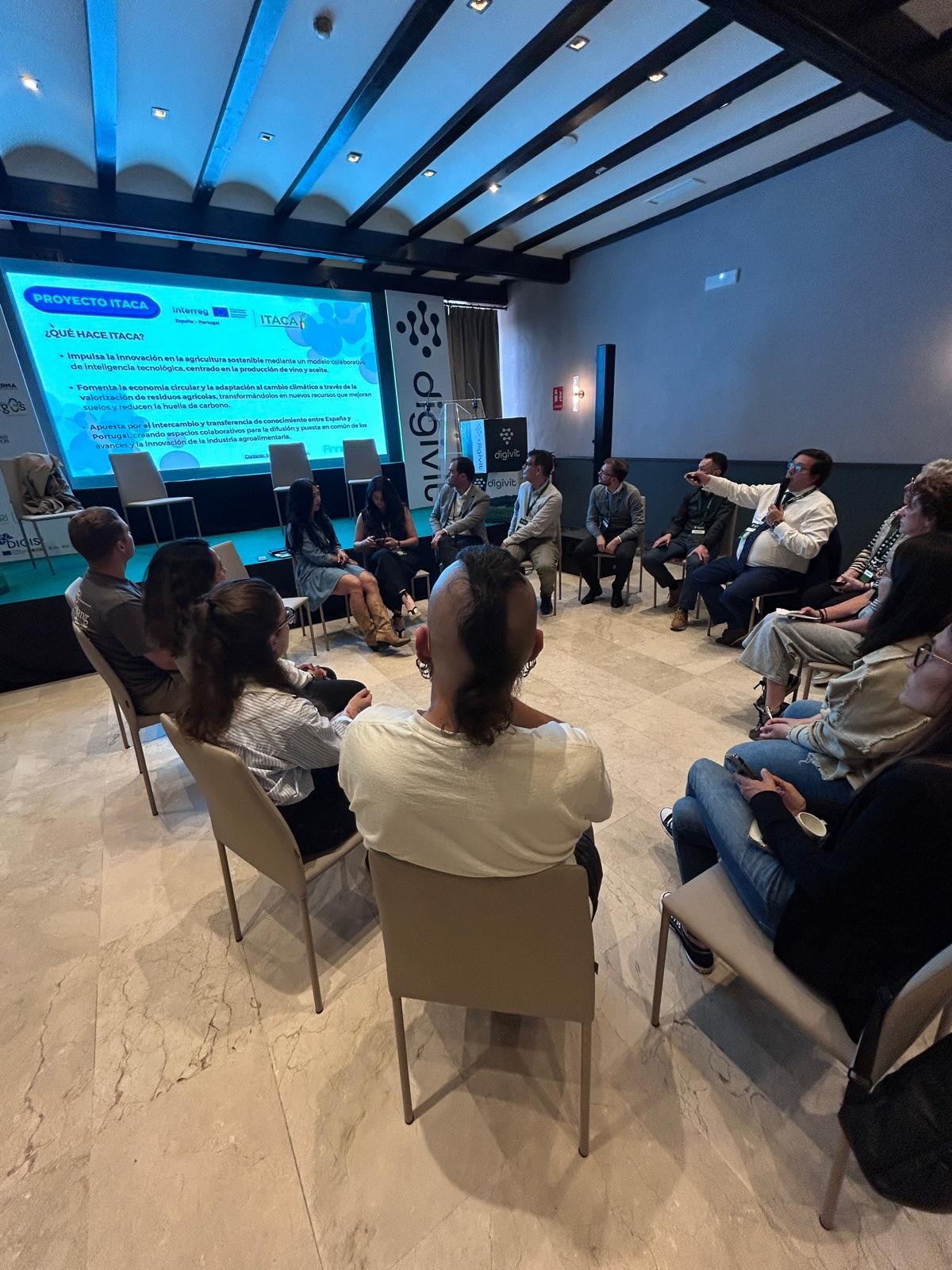
The recently launched European Interreg project, ITACA, was showcased as an example of innovation and collaborative work in the wine sector during DIGIVIT, the trade fair dedicated to the sector’s digitalisation, which took place on 29 and 30 April. The event brought together industry professionals from across Spain.
During the fair, ITACA was presented as an innovative model of cooperation for the revaluation of by-products generated in the wine production chain. In other words, an example of the circular economy and innovation in which digitalisation plays a fundamental role.
The Director General of the Finnova Foundation, Juan Manuel Revuelta, explained that within the framework of innovation “it is very important to provide training in new opportunities” and emphasised that, in this regard, the ITACA Project aims to create collaborative spaces for the dissemination and sharing of advances and innovation in the agri-food industry.
A model that Revuelta has deemed “of the utmost importance” for disseminating knowledge and developing projects that give rise to new opportunities within the sector, thereby promoting the circular economy and its digitalisation.
Within this context, he also cited the “From Vine to Bottle” project as an example, which forms part of the European LIFE programme. This initiative “analyses the wine production process and how to minimise its potential impacts”, as Revuelta explained.
Another project Revuelta presented at DGIVIT was BIOVID, which was carried out as part of the European LIFE programme. “Its aim was to provide an alternative to the burning of vine shoots that were harmful to the vines, which generated CO2 emissions and posed a fire risk,” he explained.
These three projects, focused on the wine sector and the circular economy, served as examples at the fair of how European funding can be used to bring ideas to fruition and develop them, and in this regard, the director of Finnova emphasised that “we must take advantage of the countless possibilities offered by the EU” for future initiatives.
“The perception of Spanish wine in Europe is very positive in terms of value for money, especially when compared to competing wines from Italy and France,” Revuelta highlighted, encouraging greater investment in the sector and the development of new opportunities.
In this regard, he also pointed out that “the EU accounts for 62% of global production”, and that in an international context where “the energy, labour and material costs associated with wine production pose a challenge”, the development of innovative projects such as ITACA that promote smart investment and the efficient and circular management of resources “is essential”.