
Valencia, 27 November 2025 – The circular economy in Europe continues to move forward, as confirmed by the latest report published by Eurostat, the statistical office of the European Union. In 2024, 12.2% of the materials used in the EU came from recycled sources. This figure, the highest recorded to date, reflects progress in the use of secondary materials and confirms a positive trend toward resource reuse within Europe’s production and consumption systems.
The circular material use rate measures the share of recycled materials that are reintroduced into the economy, compared to the total materials consumed. In comparison with 2023, the indicator rose by 0.1 percentage points, and by 1 full point since 2015. While still moderate, this increase signals the growing impact of sustainability policies promoted by the European Union, such as the Circular Economy Action Plan, which aims to double the EU’s circularity rate to 23.2% by 2030.
Against this backdrop, the C-SUSTAIN project—funded by the Erasmus+ programme—acts as a direct response to the need to prepare a new generation of young people to lead the shift toward a more circular economy. C-SUSTAIN offers training in sustainable entrepreneurship and circular economy for youth from multicultural backgrounds, equipping them with the tools to create business models that are environmentally conscious and socially responsible. The project, which spans 24 months, is built on two key European frameworks: EntreComp, which promotes entrepreneurial skills to turn ideas into value, and GreenComp, which fosters critical thinking, environmental responsibility, and sustainability-driven action.
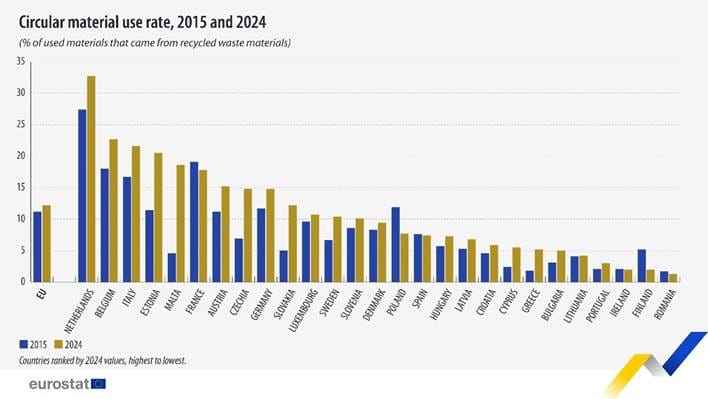
The Eurostat data also reveal considerable differences between EU countries. The Netherlands (32.7%), Belgium (22.7%) and Italy (21.6%) lead the ranking with the highest circularity rates, while Romania (1.3%), Finland (2.0%), Ireland (2.0%) and Portugal (3.0%) fall well below the EU average. Between 2015 and 2024, 21 countries improved their circularity rates, with Malta (+14 pp), Estonia (+9.1), and Czechia (+7.9) showing the most significant gains. However, six countries saw a decline in performance, including Poland (-4.2) and Finland (-3.2).
The report also identifies which materials are being recycled most efficiently across Europe. In 2024, metal ores had the highest circularity rate at 23.4%, followed by non-metallic minerals (14.3%), biomass (9.9%), and fossil energy materials/carriers (3.8%). This material breakdown provides insight into the sectors making the most progress and those still heavily reliant on virgin resources—especially textiles, construction, and tech industries.
In this context, C-SUSTAIN stands out as a strategic educational initiative that trains young people to understand and address the challenges of circularity, while encouraging them to develop innovative solutions that reduce dependency on raw materials and support Europe’s green and digital transitions. Through digital learning modules, hands-on activities, self-assessment tools, and collaborative events, the project empowers youth to take active leadership roles in their communities.
The project is delivered by a European consortium comprising BildungsLAB – Hands&Minds Learning Center (Austria), CRADLE SINGLE (Greece), Fundacja Instytut Europejski (Poland), EUth – Förderung der Individualität von Jugend in Europa (Germany), Roscommon Integrated Development Company (Ireland), and the Finnova Foundation (Spain). Together, these partners work to promote a more inclusive, sustainable, and resilient Europe through youth education and empowerment.
The recent Eurostat report reinforces the notion that progress in the circular economy is achievable, but not automatic. It requires political will, infrastructure investment, innovation, and—most importantly—education. At C-SUSTAIN, we are committed to ensuring that young people are not only part of the change but are leading it.
Source: Eurostat (2025). Over 12% of materials in the EU come from recycling – Circular material use rate, 2024
🔗 Read the full article on Eurostat: Over 12% of materials in the EU come from recycling – News articles – Eurostat
Funded by the European Union. Views and opinions expressed are however those of the author(s) only and do not necessarily reflect those of the European Union or OeAD-GmbH.
Neither the European Union nor the granting authority can be held responsible for them.
Project number: 2024-1-AT01-KA220-YOU-000247886