
- The meeting brought together scientists, public authorities and key stakeholders to strengthen coordination and foster dialogue between science, policy and the blue economy.
- The event featured institutional messages from Dubravka Šuica, European Commissioner for the Mediterranean; Željana Zovko, Member of the European Parliament and Member of the Committee on Fisheries; and Andreea Strachinescu, Head of Unit at DG MARE.
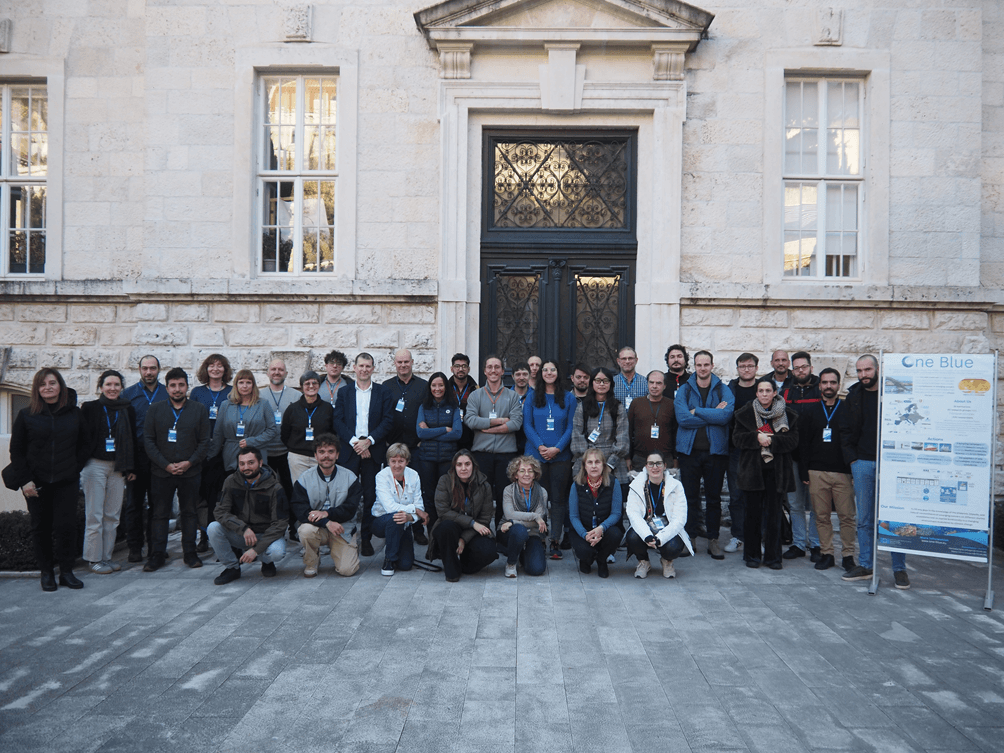
The European project ONE-BLUE held its annual Consortium Meeting and an open cross-sectorial dialogue event at the University of Dubrovnik (UNIDU), Croatia, to strengthen scientific coordination and foster exchange between science, public policies and key blue economy stakeholders.
On 27 January, the Consortium Meeting brought together project partners to review research progress, share results and agree on next steps within a project focused on the impact of emerging contaminants and climate change on marine ecosystems in the Atlantic, Mediterranean and Arctic regions, and the new technologies developed in the project. On 28 January, the 2nd ONE-BLUE Cross-Sectorial Meeting, open to the public, gathered the scientific community, policymakers, public authorities, territorial actors and related European projects to present ONE-BLUE and promote synergies in support of marine environmental protection in Europe.
EU institutional remarks
The opening featured a video message from Dubravka Šuica, European Commissioner for the Mediterranean, who highlighted the value of ONE-BLUE’s work and stressed the need to deliver tangible results in water security, climate resilience and a sustainable blue economy, based on robust scientific standards. This was followed by a live online intervention by Andreea Strachinescu, Head of Unit at DG MARE, who addressed EU maritime policy and the blue economy, underlining the role of ocean observation and integrated data in supporting evidence-based policymaking, in the context of the European Ocean Pact.
Following the general presentation of the ONE-BLUE project by its coordinator, Marinella Farré (IDAEA-CSIC), the programme continued with contributions from institutional actors, research centres and European projects, sharing concrete examples of work on coastal resilience, environmental health and applied solutions.
Stakeholder and project contributions
Petar Maleta (Regional Development Agency of Dubrovnik–Neretva County) presented lessons learned on coastal stewardship and climate resilience from multi-stakeholder EU projects. Dolores Grilec (Public Health Institute of Dubrovnik–Neretva County) outlined the local beach water quality monitoring system, highlighting its relevance for public health and local management. From a scientific perspective, Rade Garić (Institute for Marine and Coastal Research, University of Dubrovnik) shared research on zooplankton in the southern Adriatic in the context of climate change.
From a technological perspective, Bart de Schutter (Technical University of Delft) presented SeaClear 2.0, focused on scalable marine litter remediation solutions combining robotics and citizen participation. Juan Bellas (IEO-CSIC) presented the sister project CONTRAST, which focuses on developing and optimising biological effect tools for monitoring emerging contaminants. Alessandra Giorgetti presented the role of EMODnet Chemistry, underlining the importance of European marine data networks in advancing open science and supporting evidence-based decision-making.
Roundtable discussion on the European Green Deal
The roundtable was one of the key moments of the meeting and served as a space for dialogue among representatives of the projects and institutions participating in the event, enabling the exchange of experiences, results and challenges in the context of the European Green Deal. Moderated by Juan Viesca (Finnova), the discussion addressed how these initiatives are contributing to EU priorities related to oceans and waters, the main environmental challenges currently being tackled, and the ongoing difficulties in translating scientific results into practical tools, recommendations and usable evidence for public decision-making.
The ONE-BLUE meeting in Dubrovnik highlighted the importance of connecting scientific knowledge, public policies and territorial stakeholders, while strengthening synergies between projects and institutions to foster solutions and European cooperation in support of healthier seas.