
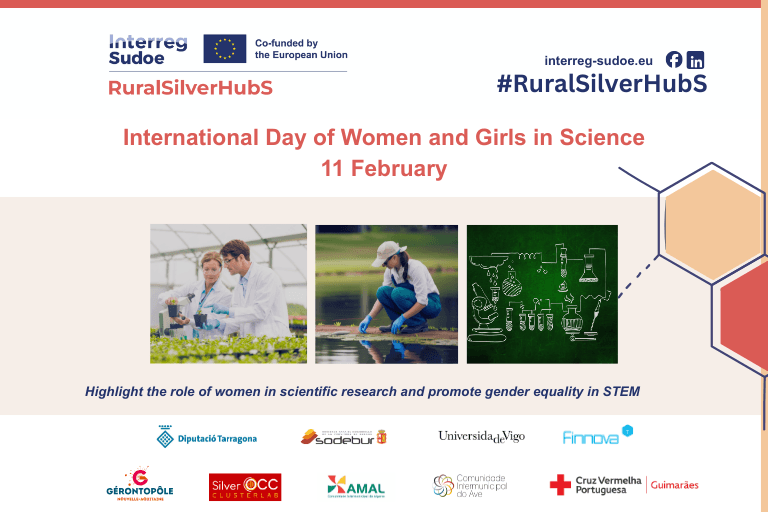
On the occasion of the International Day of Women and Girls in Science, celebrated on February 11, the European project RuralSilverHubS highlights the role of women scientists as drivers of knowledge, innovation, and territorial cohesion. The project places a spotlight on female role models connected to different territories within the SUDOE area (Spain, Portugal, and France) and on their contributions throughout their professional careers.
This year, the International Day of Women and Girls in Science focuses on gender bias and the challenges associated with digitalisation—areas to which RuralSilverHubS responds by promoting innovation ecosystems in rural areas that integrate a gender perspective, co-creation with older people, and the development of accessible and inclusive digital solutions.
Did you know that in the SUDOE territory there are women scientists with remarkable career paths? Let’s take a look at some of them:
From Catalonia, Carme Torras stands out as a mathematician and internationally recognised researcher in robotics and artificial intelligence, known for her work on the ethical application of technology in the service of people. Her career exemplifies how science and innovation can help improve quality of life, particularly in contexts shaped by population ageing.
In Portugal, Elvira Fortunato represents an undisputed role model of female scientific leadership. A world-renowned researcher in sustainable materials and paper electronics, and the first woman to serve as Portugal’s Minister of Science, Technology and Higher Education, her career demonstrates the impact of science applied to sustainability, innovation, and territorial development.
In southern France, the career of Françoise Barré-Sinoussi, Nobel Prize in Medicine laureate for the discovery of HIV, highlights the fundamental contribution of women to science and public health. Her long-standing research and outreach activities reflect the value of knowledge and experience throughout an entire professional lifetime.
Likewise, from the Nouvelle-Aquitaine region, Isabelle Lesterpt provides key insights into ageing from both a scientific and territorial perspective. Her work in the field of gerontology and public policy reinforces the importance of social innovation and a place-based approach in addressing demographic challenges. She also actively participates in the RuralSilverHubS project, contributing to the development of innovative approaches to tackling ageing in rural territories across the SUDOE area.
These career paths reflect values that are fully aligned with RuralSilverHubS—a project that promotes innovation ecosystems in rural areas by integrating science, experience (silver), social innovation, and a gender perspective to address challenges such as population ageing and rural depopulation in the SUDOE area. Highlighting female role models in science helps inspire scientific vocations among girls and young women, while also recognising the key role of silver women as generators of knowledge and social change.
About RuralSilverHubS
RuralSilverHubS is a European cooperation project co-funded by the European Regional Development Fund (ERDF) through the Interreg Sudoe Programme. With a duration of 30 months (2025–2027), the project brings together partners from Spain, France, and Portugal with the aim of improving the quality of life of older people in rural areas through social innovation, co-creation, and the promotion of the silver economy, contributing to the development of more inclusive, resilient, and sustainable rural territories.