
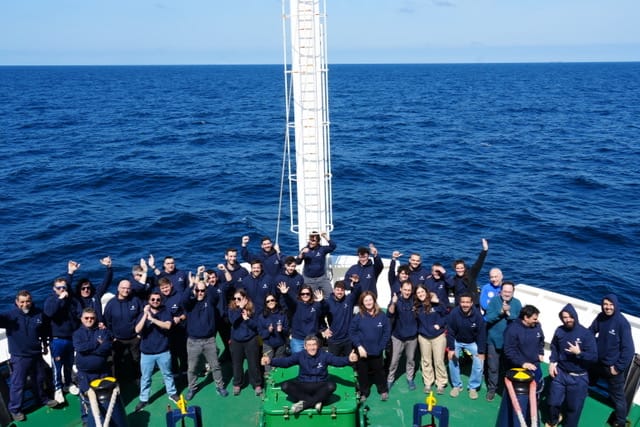
- ONE-BLUE has completed its three main case studies in the Mediterranean, the Atlantic and the Arctic during the first two years of the project
- The results will help advance the comparative analysis of emerging contaminants across marine regions exposed to different environmental pressures
The European project ONE-BLUE has successfully completed, during its first two years of implementation, the major sampling campaigns planned across its main case study areas: the Mediterranean Sea, the Atlantic Ocean and the Arctic Ocean.
This marks a key milestone for the research, as it will enable comparative analysis across marine regions exposed to different environmental pressures.
The last of these campaigns has just taken place in the Atlantic Ocean, on board the Spanish oceanographic research vessel Sarmiento de Gamboa. In operation since 2007, the vessel can accommodate up to 25 scientists and technicians and is equipped with six specialised laboratories to support advanced marine research.
The expedition was led by Montse Sala, from the Institut de Ciències del Mar (ICM-CSIC), and involved a team of 15 researchers: seven scientists from ICM-CSIC, seven from IDAEA-CSIC -including the project coordinators, Marinella Farré and Marta Llorca- and one researcher from Morocco’s National Institute of Fisheries Research (INRH). The campaign followed a route from Vigo to the Cantabrian Sea and Málaga, also including sampling in Moroccan Atlantic waters.
During the 18-day campaign, the team sampled 41 stations across both coastal and deep-sea environments, reaching depths of up to 4,500 metres. In total, more than 1,500 samples were collected, including seawater, sediment cores, airborne particulate matter, micro- and nanoplastics, as well as samples for biodiversity studies.
The main objective of these campaigns is to characterise the patterns of occurrence of contaminants of emerging concern (CECs) in coastal and deep-sea ecosystems, identify the pathways through which these pollutants are distributed, and analyse their interaction with microbial communities that form the foundation of marine ecosystems
European science to protect ocean and human health
Running from 2024 to 2027, ONE-BLUE seeks to deepen scientific understanding of how emerging contaminants interact with climate change-related stressors, affecting marine biodiversity and, ultimately, human health.
The international consortium brings together entities from 11 European Union Member States: Belgium, Croatia, Cyprus, Germany, Greece, Ireland, Italy, the Netherlands, Portugal, Spain and Sweden. By integrating expertise in environmental chemistry, marine biology, genomics and ecotoxicology, the project aims to generate robust scientific evidence to support the development of European environmental and public health policies.
Throughout the project, the thousands of samples collected during the different expeditions will undergo advanced laboratory analysis. The resulting data will be integrated into an open-access digital platform designed to foster scientific collaboration, enhance transparency and contribute to European strategies for ocean protection and sustainable water management.
With the completion of this Atlantic expedition, ONE-BLUE reaffirms Europe’s commitment to addressing one of the most complex environmental challenges of our time: the combined impact of emerging chemical pollution and climate change on aquatic ecosystems and human well-being.